The idea of theocentric posthumanism begins with the thought that there was a pre-humanism from which Western humanism deviated. Thereafter, the grand narrative of humanism played out over four centuries until its exhaustion by the end of the twentieth century. On the theocentric view, this exhaustion was inevitable given the foundations of human nature and ethics that it borrowed from its Judeo-Christian origins, and thus humanism must be transcended. However, a decision must now be made as to whether this can be an immanent, conceptual transcendence towards the material Other, or it must be a supernatural transcendence towards a fundamental reality upon which all material systems depend. For example, do immanent posthumanisms merely inherit all of the contradictions of the humanistic urges they seek to replace?
For now, I merely propose to set out an approximation of that grand narrative as it played out in Western Civilisation since the Renaissance, to set a backdrop, as it were. All periods are approximate in their extent and extreme in the generality of their description.
THE MEDIEVAL PERIOD – 400 to 1400
In the history of Europe, the Middle Ages or Medieval Period lasted from the 5th to the 15th century. It began with the fall of the Western Roman Empire and faded into the early Renaissance. The period is characterised by the rise of Christendom, following Constantine’s declaration of Christianity as the official religion of the Roman Empire. From this time, the right to govern became entangled with the observance of orthodox religious practice, resulting in the political centrality of the Church.
The Medieval Christian view was that God is the centre of value in the universe, and humanity derives its value from bearing God’s image. However, as that image was tainted by original sin, humanity cannot do anything good except by the grace (special gift) of God. Receiving this grace came to be linked with accepting social traditions, which effectively meant that nothing could be done to change society for the better. As society was already holy and not to be reformed by rulers, rulers were judged, instead, by the ways that their virtuous lives attracted divine blessing. These virtues came to be defined later by the chivalric code, which is a pious warrior code.
THE RENAISSANCE – 1300 to 1600
In this period, long-lost art and literature of the Ancient Greek and Roman civilisations was rediscovered, and it inspired new artistic and cultural movements that mimicked and developed classical styles. In the process, stories and images from Greek and Roman mythology were adapted for contemporary audiences. For this reason, pagan gods, mythical monsters and classical heroes are featured in Renaissance art and literature, along with ideas of humanism implicit in classical rhetoric, history and moral philosophy.
This was not initially a challenge to theocentrism or the doctrine of human depravity. It was humanism in the limited sense of a developing belief in the human potential to be educated and use that education to improve social and material conditions, to a limited extent, through good governance. Basically, it was a movement to educate lay leaders (nobility) using classical texts that focus on practical skills and outcomes, but it implied, for the first time in a long time:
- humanity’s ability to control politics and one’s destiny; and
- the judgement of political action according to its consequences in outcomes of human flourishing.
Within this was the mere kernel of a philosophical humanism that finds expression ahead of its time in Thomas More’s Utopia (1516). This increasingly implied philosophical humanism is the view that humanity is the centre of value in the universe, and that humans are exceptional in possessing the potential for moral goodness, creativity, freedom, discovery and civilisation. Furthermore, the success of any society is to be measured by the extent to which it promotes the flourishing (health, prosperity and realisation of potential) of its members. Rulers began to be judged more overtly according to how well they were able to deliver a stable and prosperous society, in which all of their subjects could flourish. As the ends justify the means, it began to become acceptable for rulers to depart from medieval virtues, if it would result in stable and effective government.
THE REFORMATION – 1517 to 1648
The Renaissance principle of returning to original texts, and the potential for humanity to achieve greater understanding through study, came to destabilise the politico-religious order. The Reformation was a movement against the Roman Catholic Church, which had dominated Western Christendom. Arguably, the influence of classical texts played a role in shifting Roman Catholic doctrine away from that which could reasonably be derived from the Christian canon, such as via Thomas Aquinas’ importation of Aristotelian metaphysics, though the drift had been happening for centuries.
Protestants chose exclusive interpretation of the Bible, rather than the Pope and cardinals of the Roman Church, as the sole source of the means to be saved. Change began in 1517, when Martin Luther nailed a document known as the 95 Theses to the church door at Wittenberg, championing the authority of the Bible. Kings and princes decided on the official religion of their subjects. Some saw the Reformation as an opportunity to end the authority of the Pope in their domain. So, wars were fought between pro-Roman Catholic and pro-Protestant rulers.
The Biblical Christianity of the Protestant reformers returned to pre-humanist idea that God is the centre of value in the universe, partly reacting to the humanism that had already begun to take hold. However, humanism as a philosophy, and human flourishing as the measure of the good, had already begun to transform the intellectual landscape of the age. The more transformative legacy of the Reformation would be its emphasis on individual conscience as an authority apart from the authority of Church and King. As each man was encouraged to read and understand the Bible for himself, this emphasis on individual reason would become the basis of the next phase of Western humanism.
THE ENLIGHTENMENT – 1685 to 1815
Deepening the Reformation focus on individualism, education and rationality, this period saw European politics, philosophy, science and communications radically reoriented as part of a movement referred to as the Age of Reason. Enlightenment thinkers in Britain, in France and throughout Europe questioned traditional authority, including established religion, and embraced the notion that humanity could be improved through rational planning. At its zenith, the American and French Revolutions were directly inspired by Enlightenment ideals, and it sparked the Industrial Revolution.
This period witnessed an explicit philosophy of anthropocentric humanism, with a philosophical shift towards humanity as the centre of all value and potential in the universe. It prioritised active human faculties of the will and reason, and exalted the human ability to understand and master the natural world through reason, science and technology. Accordingly, human nature (essence) is defined in rational and dualistic terms, the stuff of the autonomous mind having been rent from the stuff of space and physical matter by the philosophy of Descartes.
The consequentialist ethic that originally meant that a ruler was justified in using any means to achieve the end of human flourishing was now applied to the people. The people were thereby justified in taking any steps necessary to overthrow a ruler who did not demonstrate concern for the common flourishing of all humanity (European men). Thus, the British colonies of North America declared the equal value and rights of all men as they revolted against unequal British taxation.
THE ROMANTIC PERIOD – 1775 to 1850
Romanticism gained force in response to the oppressive working conditions of the Industrial Revolution, and the bloody Reign of Terror that followed the French Revolution. The Enlightenment’s emphasis on human reason at the expense of other intuitive faculties, such as sensation, imagination and emotion, was held responsible by some Romantics for the negative aspects of revolution. The role of the artist in bringing the people back in touch with nature and a sublime sense of unity between all men took on new importance in the politics of revolution
As a counter-Enlightenment movement, Romanticism opposed rational organisation of society and culture, esp. the early industrial revolution alienating and oppressing a newly urbanised working class. It prioritised the passive human faculties of intuition (sensation, imagination and emotion), and exalted human connection and submission to sublime natural forces. Accordingly, human nature (essence) is defined in emotional and imaginative terms, and by increasing rejection of mind-body dualism in order to stress continuity between humans and with the natural world.
THE VICTORIAN PERIOD – 1837 to 1901
Ultimately, Enlightenment and Romantic revolutionary movements failed to bring down the conservative monarchies of European Christendom, apart from that of France, because rulers found ways to shift the justification for their rule from divine right to a sense in which they represented the will of the people. This was achieved through incremental democratic reform in Victorian England, and due to the relative prosperity that Imperial Britain could deliver to the masses by exploiting its now expansive colonised territories, especially India. Thus, the rhetoric of nationalism and humanism that had once belonged to Enlightenment and Romantic revolutionaries was being used to prop up the aristocratic establishment.
The official religion was still Christianity, but humanism dominated popular morality, driving many to religious nominalism and Nietzsche’s declaration, “God is dead.” Darwinian evolutionary theory challenged the Genesis account of Creation, but also provided quasi-evolutionary justifications for holding to both egalitarian humanism and racist colonialism, i.e. some people were more human than others on a progressive evolutionary scale. This was not enough to prevent an American Civil War over the inequality of African-American slaves, to prevent women becoming consciousness of their own equal humanity and political agency, or to prevent others, e.g. Karl Marx, relating humanism to the overthrow of the new capitalist class by international workers.
Developments in science and technological gave rise to a new utopianism leading into the modernist period, which started as a search for new cultural forms commensurate with the renewed faith that humanity’s potential and inevitable progress would lead to new societies of human flourishing.
MODERNISM & THE CRISIS OF HUMANISM – 1914 to 1960
What did bring down the ancient monarchies of European Christendom was World War I. Before 1914, the tensions between Christianity, humanism, science and colonialism caused many to abandon traditional ways of thinking and seek entirely new justifications for humanism and Western civilisation. So, the Great War might have been welcomed in ending Christendom, had it not so alarmingly shown the capacity for humanity to destroy itself. Some sought hope for humanism in grand ideologies, such as communism and fascism, but the violence and atrocities of the interbellum period and World War II began to make utopian grand narratives seem like totalitarian deceptions.
After the moral horror of WWI began the Crisis of Humanism, the first positive response was a reactionary return to Romanticism during the interbellum period, appealing to the compassionate and imaginative capacities of humanity to moderate the coldly rational excesses of the Enlightenment project and capitalism. The second positive response came after the renewed horrors of WWII, with the rise of existentialism. That is, roughly the philosophical position that the world and human life has the persisting appearance of being meaningless and absurd, but that humanity is nevertheless responsible for facing the abyss as though humanism were true. Such an oppressively stoic worldview could not be sustained for long.
Furthermore, WWII had exhausted the former colonial powers and former colonies began to assert their independence. It might be expected that the ethnic groups that had been oppressed by colonial policies would then have produced intellectuals who would stake a claim upon the human nature equal to that of their former colonisers. That was the first wave. However, another perspective began to emerge…
POST-MODERNITY – 1960 to …
Postcolonial theorists began to argue that human nature is a colonial construct designed to oppress colonised peoples. For the first time in 400 years, something other than humanity was being put forward as the centre of value in the universe: the Other. In fact, the Other is not one centre of value, but many. There are many Others whose distinct dignity and value must be recognised. This approach to demanding recognition featured in the US Civil Rights Movement by the 1970s and, from there, to similar movements for the equal recognition of homosexual, transgender and animal rights.
In short, the Crisis was ended in intellectual circles by abandoning exclusive humanism for many centres of value and potential in the universe, relying on one or more aspects of a threefold critique:
- the 20th Century demonstrated the moral fallibility of humanity by humanism’s own lights, taking humanity at its highest;
- humanity as a concept has been constructed arbitrarily to exclude and oppress, e.g. the colonised, the marginalised, animals etc.; and
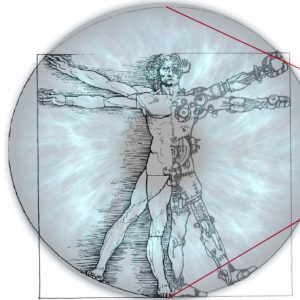
- there is no scientific basis for prioritising or distinguishing humanity, which is just another evolutionary stage, intermingled with technologies and other species, without definitive genetic boundaries.
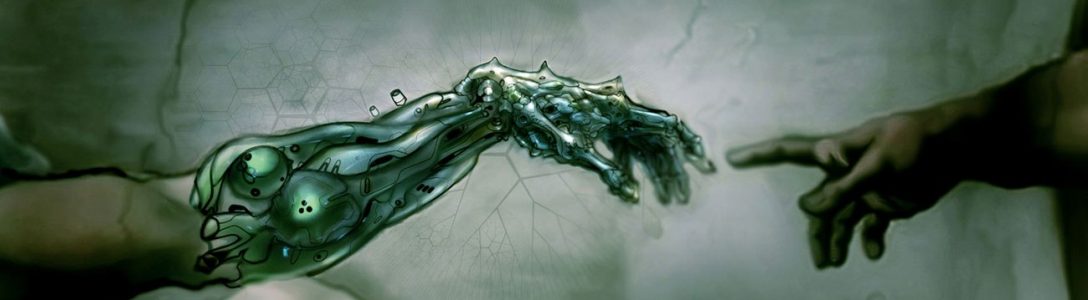
It was not just the failure of secular humanists to find a justification for humanism apart from a latent, supernatural picture of humanity bearing the divine image. Rather, it was that there is nothing scientifically observable that suggests the categorical distinctiveness or transcendence of humanity. The next stage could be genetically or cybernetically enhanced, or purely synthetic. Or, perhaps, it will be more highly integrated with the ecologies and forms of life that support its evolutionary development.
Still, there is lingering doubt that there can be many centres of value without the whole thing collapsing into nihilism. There is a niggling sense that it means something to be human, something special.

 Theocentric Posthumanism