
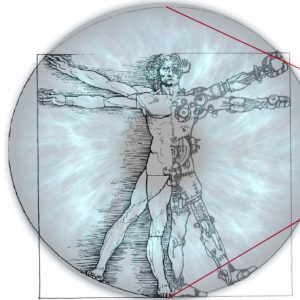
Before moving on to other matters, I thought that it would be worthwhile to address another argument for the situated and contingent nature of human reason that feeds into the poststructuralist bias towards anti-humanism.
Influenced by Friedrich Nietzsche, Martin Heidegger, in Being and Time (1927), stressed a problem with the received view that information about the world is gained directly through perception. The problem is that the world as we experience it does not appear to give us any information that we do not actively interpret it as having. Our understanding of the world is interpretation all the way down and so our experience is just what we construe it to be. Heidegger took the view that the resistance we experience when we encounter the world is explained as the determination of our interpretations by our socialisation or enculturation into a tradition or historical epoch, which he termed ‘being-with-others’. Jacques Derrida combines this picture of interpretation all the way down, with a structuralist theory of signs, as a stepping off point for his deconstructive method and his fundamental non-concept of differance… err… ahem… which is to say, he pushes Heidegger’s anti-humanism of historicised rational faculties even further, to the point of equating the categorising tendencies of reason with the impositions of power. Heidegger relativises reason to an epoch; Derrida relativises it to some slippery region of discourse.
In the Anglophone philosophical tradition, Wilfred Sellars in ‘Empiricism and the Philosophy of Mind’ (1956) noted a similar problem, which he dubbed the ‘Myth of the Given’, i.e. that sense data produces concepts about the world we experience. It is a myth, because the sense data of experience seem to be the wrong kind of phenomena to explain the production of information-rich concepts in our minds about things and stuff in the world. At the very least, it is unclear as to how an empirically induced concept would correspond with some object out in the world based on the relatively poor amount of information that could be transferred along a causal chain that terminates in perceptual cognition. In discussing this problem, John McDowell in Mind and World (1994) evokes the disturbing image of a mind spinning frictionlessly in the void.
Contemporary solutions to this problem from an Anglophone perspective often follow Heidegger’s solution of the social construction of perception and/or reason, which again leads to the relativisation of knowledge or reason to some epoch, community, culture etc. In the American context, this follows the historical influence of American pragmatism originating with C. S. Peirce and William James circa 1900, whose offered ideas bear similarity to those of Heidegger in the Continental context. The trouble for all of these approaches comes in attempting to detail ways in which members of the same community come to share an understanding of the world, in any plausible sense, without recourse to some informational inputs via direct perception, which is the phenomenon to be explained.
These arguments about the inadequacies of perception for objective human knowledge are the internal equivalent of the anti-humanistic argument from the outside made by Foucault in The Order of Things. Once again, the human capacity for objective knowledge can be maintained, from this internal perspective, using the transcendental argument for theocentrism raised in my previous post. We do appear to gain objective knowledge of the world from our experience. Furthermore, when we reflect on the immediate presence of our experience to us, it appears inadequate to explain the objective knowledge that we acquire in this way. The parallelist view of a pre-established harmony between the historical development of the universe according to physical laws, at all levels, and the development of minds with their concepts about the world, can be adapted to bridge this gap, also. Each mind is determined by providence to interpret sense data in a way that generally corresponds with ways that the perceived local environment really is, despite the poverty of the information stream presented by sense data or the causal inputs by which they are induced.
Believing such a parallelist view of divine determination is still a big ask, but there is more to be said about the ways in which a theocentric posthumanism is the right way to leap when abandoning the sinking ship of humanism.


[…] as to the boundaries of their concepts, using the same kind of parallelism that I discussed in my last post. Just as God determines that our experience of the world induces the correct concepts about the […]
LikeLike
[…] by the same parallelism as the interpretation of observation and perception, dealt with in this previous post. However, this analogy with perception generally suggests that texts that are candidates for divine […]
LikeLike