Anti-humanism is, at its core, an anti-essentialism. This will take some setting up.
The essence or nature of something is an absolute answer to the question, “What is it?” That is, an essence is what something is independently of any temporary context or state. That is a tree, this is a planet, I am a human etc. Such kinds are, ostensibly, fundamental and cannot change for each referenced thing, unlike temporary kinds like that of a sapling, a fertile planet or a teenager.
The way that we talk about essences divides into descriptive and prescriptive essences. A descriptive essence can be analysed as the cluster of properties that a thing must have in order to continue existing under any possible circumstances. In other words, it is the limit to the range of changes that something of its kind can undergo without ceasing to exist. For example, cutting my hair is a non-essential change, but cutting of my head is an essential change that will destroy me, or at least my body (maybe it is just an essential change for human bodies, but not human minds). In still other words, descriptive essences are the conditions on identity persisting through change, which may be why the terms ‘essence’ and ‘identity’ have become conflated in contemporary, popular discourse, e.g. as with ‘identity politics’ or ‘gender identity’.
Prescriptive essences, on the other hand, can be analysed as the cluster of properties that a thing of its kind must have or increasingly acquire in order to flourish or achieve an inherent, primary purpose. It is the telos of a thing, which it does not need to instantiate in order to exist, but which it should instantiate in order to fulfil some normative direction of its existence. It is the measure of the good for that kind of thing. Living things, in particular, can show signs of wilting and decay thought to indicate that they are not fulfilling their prescriptive essence – their good – though they may persist in that poor condition for a very, very long time. Arguably, prescriptive essences need descriptive essences, but not the other way around, which will become important in a future post, no doubt.
Essentialism is the view that some or all of the kinds that we regard as essences are objectively out there in the world, attached to or suffusing things, and not just an aspect of the way we talk about things around here. It helps to think more broadly about natural kinds and natural properties. Imagine a space that has all possible things in it. All things that could exist at any time or place pop into this space. We might include impossible things as well, but let’s not go nuts for now. Now, our concepts divide this space up (perhaps precisely, perhaps vaguely) into two regions: the things that fall under the concept and the things that do not. If I think of cats, then all possible cats are divided from all possible non-cats in the space of all possible things. If I think of houses, then I carve up the space into all possible houses and all possible non-houses.
Now, some of the ways that my concepts carve up this space of all possible things might be more natural than others. It is as though the possible things grouped together by some concepts belong together, objectively, in a way that goes beyond the mere fact that my concept refers to them collectively. The elements of the periodic table might be a good example of natural properties and kinds. Maybe, all things made of gold, and all atoms of gold, belong together in a way that does not rely on my concept of them. Things made of gold mixed with other elements, or incorporating parts made of other elements, do not fit together under a concept quite as well, lacking purity or naturalness. This naturalness captures the more or less correct or appropriate ways that our concepts, expressed by our language of kinds and properties, carve up the space of all possible things.
So, essentialism is the view that some or all of the kinds that we regard as essences are natural kinds that carve up the space of all possible things in very apt ways. They are not kinds that depend on our concepts of them to group their instances together and, in some sense, we are more correct in our thinking when we think about things as having these essences. Anti-essentialism, therefore, is the opposing view that some or all of the kinds we regard as essences are only grouped together by our concepts of them, and the space of all possible things could just as easily be carved up in other ways with no loss of meaning or truth.
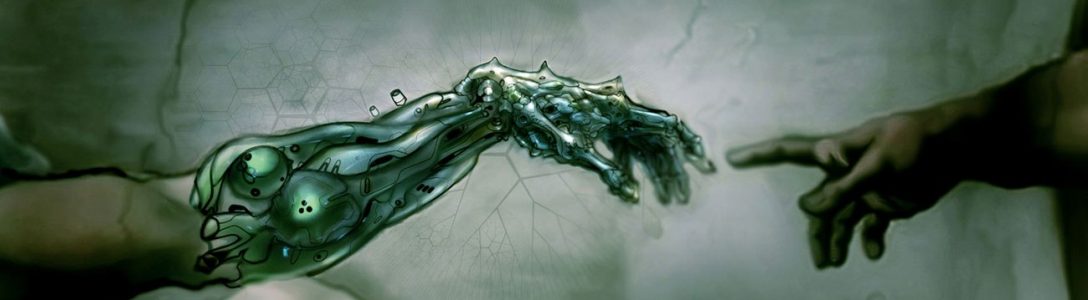
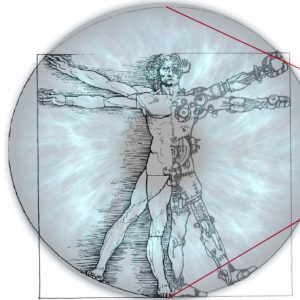
Okay! Now that all that has been front-loaded, we can talk about Donna Haraway’s anti-humanist anti-essentialism (towards a critical posthumanism) in her oft-cited essay, A Cyborg Manifesto (1991). Haraway argues against the idea of an original, pure humanity from which marginalised individuals depart, in favour of the cyborg, a figure of hybridity and impurity. Her primary negative argument against the concept of human nature or human essentialism can be summarised by the statement that we are always already cyborgs, i.e. there is no pure form of humanity. This can be taken as a stance against regarding humanity as a natural kind, in the sense just defined, particularly as Haraway expands on this point by demonstrating the ways in which any principled distinction between the human and the non-human has become untenable.
Haraway discusses three boundaries between the human and non-human that have broken down. Actually, she discusses two, but the second and third are pretty much the same distinction. Firstly, she raises that between human and animal. Features such as language, tool use, social interactions and our internal mental life are increasingly seen as functionally continuous with comparable features in animals. Evolutionary biology and genetics have also rendered humanity ontologically continuous with animals, yielding no decisive structural or compositional essence of humanity to distinguish us objectively from organisms earlier and probably later in human and parallel lines of descent. In brief, we are but a passing stage in deep evolutionary history, accompanied by the passing stages of other organisms.
Secondly, the boundary between the human and the machine is increasingly blurred in functional terms, as machines prove to be increasingly capable of simulating human cognitive and physical functions. We stand at a point in history when the Singularity seems to be a possibility, when AI will become self-sufficient, self-replicating and self-enhancing. So, the redundancy of humanity’s functional uniqueness in comparison machines is nigh, if not here. That we are already cyborgs derives from the very possibility of lacking functional distinctiveness, because it shows that the concept of human nature cannot be delimited by its functions. However, this realisation is made more evocative by a thought experiment involving the cyborg of popular science fiction. We are increasingly able to replace human organs and tissues with artificial prostheses. If we could continue replacing body parts, one by one, at what point would an individual cease to be human? The lack of any criteria to determine this question makes the point that we are already such cyborgs. We are already without a human nature that is objectively distinguishable by unique functionality, in contrast to the potential of machines.
This refutation of the functional uniqueness of humanity can be expanded to include the external incorporation of machinery as a feature of the human body with the argument that the functions performed by bodies are not merely extended but transformed by transitory relationships to developing external technologies and socially deployed instrumentalities. For example, it is not just that computers help us to think, they actually change the structure and function of the thinking that we perform, and even what counts as thinking. This further argument that human functions are not just replicable by, but grounded in technologies (and, also, co-evolving species) and their social deployment around a socially constituted subject will likely be discussed further in relation to other thinkers, in future posts.
Haraway’s positive claim is that the cyborg’s confusion of boundaries – the posthuman condition – should be embraced as a welcome advance towards outcomes conducive to a more ethical way of being embedded and embodied in the world, because it more authentically reflects our age. However, it is possible to embrace anti-essentialism about humanity without abandoning a special status for humanity. Obviously, I am talking about theocentric posthumanism, again.
In the High Middle Ages, pre- Renaissance, there was a debate within scholasticism over this very issue. The opposing views can be regard as positions on a spectrum starting from full-blown essentialism, regarding both descriptive and prescriptive essences as objective features of the way the world is, and ending with complete anti-essentialism. Thomas Aquinas (1224 or 1225 to 1274 CE) adapted an Aristotelian metaphysics to Christian doctrine, and thus stands at the full-blown essentialist end. Duns Scotus (1266 to 1308 CE) is somewhere in the middle, and William of Ockham (1288 to 1347 CE) got pretty close to the other end of the spectrum. Their differences over prescriptive essence, or telos, can wait for a future post. Most immediately relevant is Ockham’s nominalism, which involves the rejection of natural kinds and properties, and which was least conducive to the Age of Humanism that followed.
Ockham regarded properties and kinds as existing only as concepts in the mind (first as a kind of fiction, though he came to think of them as a kind of action), which means that there is no objectively correct or apt way to carve up the space of possible things with one’s concepts. Once the boundaries of a concept are set, there is an objective fact of the matter as to whether or not anything actually exists that falls within the concept, but there is no right way to set those boundaries. Contemporary Anglophone philosopher John Searle endorses this view in his The Construction of Social Reality (1995), calling it conceptual relativism. The problem then becomes how people ever agree upon what they are talking about, when we cannot guarantee that our concepts have the same boundaries. We might constantly be talking past each other.
Those who believe in natural kinds and properties can explain conceptual agreement by the way in which these objectively correct boundaries of concepts act as “reference magnets”, ensuring that people agree on the more natural meanings of general terms most of the time. Reject that, and another approach is that of Searle, who theorises that the shared practices and social capacities of a community ensure that we are disposed to come up with the same boundaries of concepts as other members of our community. This is a nice explanatory story, but it remains a bit of a black box as to how community practices and capacities are meant to do this.
Ockham had the advantage of falling back on his theism in order to solve the problem, because God has a mind, too. So, the only way that concepts are in any way privileged is by corresponding to the way that God’s concepts are delimited. This provides a mechanism to explain agreement between people as to the boundaries of their concepts, using the same kind of parallelism that I discussed in my last post. Just as God determines that our experience of the world induces the correct concepts about the world within our minds by means of a pre-established harmony, God also ensures that there is conceptual agreement between individuals by means of the same pre-established harmony. Now, this part is not how Ockham would have seen it, because he placed a high importance on free will, and free will is not something that is going to survive a robust posthumanist perspective. Still, it is a view that would fit with Ockham’s nominalism were it to be relieved of unnecessary commitments to a metaphysically deep kind of free well.
Bringing this back to the very concept of human nature, that essence may be a very messy concept indeed, with all kinds of vague, arbitrary and historically differentiated boundaries. Now that the only kind of objective boundaries are provided by concepts in the mind of God, there is no reason that the concept of humanity must have the hallmarks of being a natural kind. Contingency or messiness does not prevent humanity from being a privileged kind – a very important essence – as long as it is the essence of things in which God has a privileged interest. So, even without essentialism or a scientific way to delimit the human, humanity remains a privileged kind. Furthermore, being a messy concept does not get in the way of comprehending and communicating it. Lots of our concepts are messy in ways that make it difficult to analyse their boundaries, and yet we get on using them without much difficulty.
In summary, by shifting the centre of the universe away from humanity and back to God, we can get a theocentric posthumanism that agrees with the anti-essentialist anti-humanism of critical posthumanism, but ends up regarding humanity as special, anyway. I am yet to unpack this shifting of the centre, but I propose to discuss it in two aspects. Recall that I define humanism as the view rendering humanity as the centre of value and potential for progress in the universe. I hope to explain what it means for each of these aspects to be shifted back to God, but I will do so in relation to some further discussion of critical posthumanism.


[…] let’s return to a spectrum of views about essences or natures, which was discussed in an even earlier post. Thomas Aquinas is the poster boy of the High Middle Ages for one end of the spectrum, which […]
LikeLike
[…] pure, drawing normative commitments from the divine will alone, as I have discussed here and […]
LikeLike