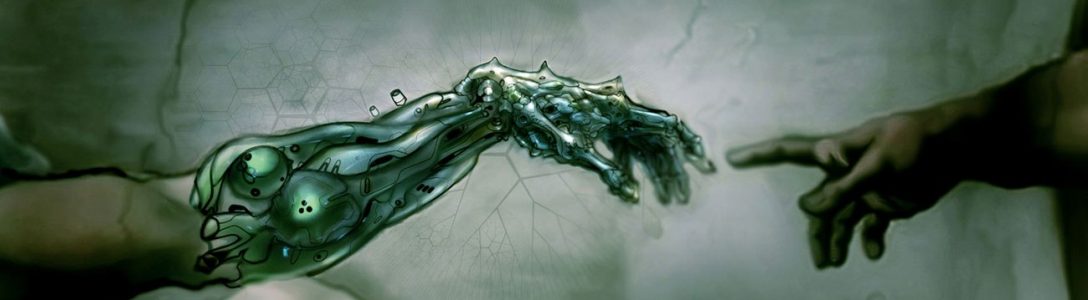
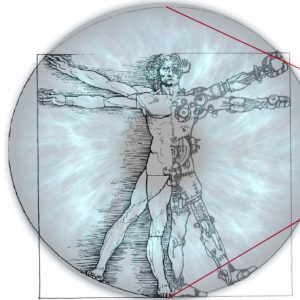
Anti-humanism is the decentring of humanity as the universal centre of value and potential for progress. Posthumanism is the re-centring of value and potential elsewhere. Transhumanism re-centres on an extended and enhanced concept of humanity. Critical posthumanism re-centres on a multiplicity of centres, including Braidotti’s strategy of re-centring on living matter in any form. Theistic or theocentric posthumanism re-centres on God. This post concerns the re-centring of value, and my next will concern re-centring of potential for progress.
The radical nature of a posthumanist re-centring of value should not be underestimated. Braidotti (The Posthuman, 2013) discusses death as something not to be feared or avoided at all costs because the forces of zoe (self-organising matter or life) within us continue after the dissolution of the self. This entails a substantial downgrading of the value of human life, despite not withdrawing all value from humanity. Still, most current posthumanist theory retains an egalitarian ethics, simply extending the class of persons or entities that can owe and be owed moral duties, or realise a form of the Good. In shifting the centre of value, however, it highlights that radical shifts in moral and ethical thinking can occur in a few generations. It shows how wrong we might be in our moral thinking right now, either absolutely or relative to a future shift in social norms. It really is a short step from a posthumanist re-centring towards a more inclusive egalitarian ethics, to an alternative posthumanist re-centring towards an exclusive chauvinism. The transhumanist fetish for enhancement could morph into a culture justifying “anti-fleshy” pogroms. The critical posthumanist valorisation of the non-human environment could lead to a “final solution” for the preservation of a biosphere plagued by the human predilection for capitalism domination.
These possibilities are raised, not as a slippery slope argument as to where such movements or theories are actually heading, but to make the point that there is no principled way to prioritise an egalitarian posthumanism over a chauvinist posthumanism. The population of Western democracies may exhibit a bias towards the former at present, but there is no way to guarantee that this will persist into the future, now that the notion of humanity’s manifest destiny has been obliterated. Indeed, I would argue that there is no principled difference between any two ethical systems except to the extent that one might be grounded in a metaethics that explains the unavoidability of ethical/moral reasons, as set out in this prior post of mine. So, the posthumanist age can be seen as a time of softening up our moral intuitions to the point of recognising a very posthumanist ethics, indeed, just so long as it can deliver on a recognisably central criterion of normativity, such as unavoidability.
With that thought, we are ready to consider re-centring the source of all value with God. In my said prior post, I set out a brief argument that the unavoidability that seems to be inherent to moral and other normative reasons (apart from merely social norms) is explained by the threat of divine coercion, i.e. the ability for God to visit overwhelmingly adverse future consequences upon those who deviate from absolute normative requirements, even to the point of suspending physical laws to do so. One question that then arises is as to the moral truthmaker: what makes moral claims true. The idea of a truthmaker can be introduced with the example of the statement, “A cat is on the mat.” The idea is that, if true, the statement is ‘made true’ by a class of three things: the cat; the mat; and the spatial relation between them (truthmaker theory has become so much more complicated than that, but let’s leave that debate alone and accept the simple idea). What, then, is the truthmaker of moral claims?
Taking inspiration from William of Ockham, again, we can regard the moral truthmaker as the will of God, which is a form of theological voluntarism. Now, Ockham’s view is complicated by his belief in human free will and the possibility of virtue apart from following divine commands, so I am not going to accept everything for which he stood. Instead, shifting the focus of morality from telos in a world of things to a will in the mind of God is an idea that can be embraced in its purity, if we have the posthumanist stomach for it. The simplest form that such voluntarism can take is that the moral truthmaker is God’s executive volition insofar as it determines the history of the universe to include ultimate, overwhelmingly adverse consequences for individuals in ways systematically related to their conduct in their finite, prior lifetimes.
There are a few side issues to addressed before explaining that last paragraph. Firstly, it could be argued that for normative unavoidability to be delivered by God’s will does not require that God’s will is the moral truthmaker, only that God enforces the prescriptions of whatever the moral truthmaker otherwise is. For example, the moral truthmaker might be a distinct platonic form of the Good, and God is simply committed to guaranteeing the instantiation of the Good. Note, however, that it seems to be a conceptual truth about moral and normative reasons that they are unavoidable. So, for the platonic form of the Good to be the moral truthmaker, there must be a necessary connection (at a high grade of necessity) between the prescriptions of the Good and the commitment of God to enforce those prescriptions, in order for the moral truthmaker to conceptually entail unavoidability. Generally speaking, high-grade necessities (logical or metaphysical necessity) holding between distinct entities require substantial metaphysical justification, if they can be justified at all, because it always seems conceivable that distinct entities could have existed without the relevant alignment between their intrinsic properties.
If we were to give the benefit of the doubt, what justification could there be for such a metaphysically problematic speculation? It will probably take the form of one of the arguments against theological voluntarism, i.e. the view that the Good is whatever God wills it to be. The most common arguments against voluntarism are that it makes morality arbitrary and it trivialises the goodness of God. To elaborate, morality is often regarded as being systemically rational, so that the requirements of the moral law can be extrapolated from relatively few moral principles. This view of morality breaks down if morality is just whatever God wills (and hopefully commands publicly) from time to time, on an ad hoc basis. Furthermore, it would seem to trivialise the widely held belief that God is good if goodness is whatever God wills it to be. It seems tantamount to saying that God is self-satisfied, which does not appear to be a strong enough attribution. Now, if the moral truthmaker were something apart from God, instead, like the platonic form of the Good, then claim that God is good becomes a more substantial claim, and the platonic form’s status as an abstract, necessarily-existing entity would seem to provide a basis for the systematic rationality of moral reasons.
That is not, however, the end of the matter. An alternative explanation of the same intuitive claims (systemic moral rationality and the goodness of God) is available by analogy to the physical laws of the universe. Those laws seemingly consist of a range of deep regularities in the way that the history of the universe unfolds, which are reducible to certain fundamental principles from which other regularities can be derived: physical laws yield chemical laws; chemical laws yield biological laws etc. Now, the systematic intelligibility of these fundamental physical laws does not seem to be compromised by the thought that they are dependent upon an initial and sustaining creative act of God, or the thought that God might occasionally suspend these laws with the event of a miracle. The physical laws remain sufficiently reliable to be systematically intelligible.
Arguably, God’s moral law works the same way. Just as the fundamental physical regularities could be dispensed with in favour of non-stop miracles, the fundamental moral principles could be dispensed with by God in favour a completely arbitrary and even contradictory series of commands. However, as long as God wills that both physical and moral laws follow fundamental principles and regularities, for the most part, they each remain systematically intelligible and, thus, non-arbitrary. So, the moral truth-maker need not be anything apart from God’s will to avoid arbitrariness, just as long as God’s willed moral law can be specified in terms of fundamental principles for the most part. Similarly, the claim that God is good can be regarded as a substantial claim, being that God faultlessly adheres to fundamental moral principles that God opts to prescribe, despite this systematic conception of the Good not holding as a matter of high-grade (logical or metaphysical) necessity, i.e. it might have been otherwise if only God had willed otherwise.
So, there is no reason (of those canvassed) to regard the moral truthmaker as anything but God’s will and, specifically, his executive volition in the process of being realised by a world history that will culminate in a time of divine judgement. Furthermore, there is a reason to think that it is most certainly not the case that anything but God’s will is the moral truthmaker, and that reason is the problem of evil. The problem of evil only becomes a problem if there is something outside of God which determines the Good, so that God’s creative act can be evaluated according to that external standard. If humanity believes that it has access to knowledge of the Good as a standard external to God’s will, it becomes inexplicable as to why the universe does not reflect that conception of the Good, except to the extent that God lacks sufficient power to realise that conception. The trouble is that the extent to which the universe does not exemplify a humanistic conception of the good, which prioritises the elimination of suffering and development towards human flourishing, suggests a very weak God, indeed. In fact, in order to explain why God allows suffering in the world that is evil according to a humanistic conception, we are talking about a reduction of God’s power to the extent that God no longer delivers on moral unavoidability, so that there can be no moral truthmaker to satisfy the criterion of moral reasons’ unavoidability.
If God’s will is the moral truthmaker, then the problem of evil is resolved in the trivial way that God does not condemn God for creating the world as it is. This is the posthumanist ethic of theocentric posthumanism. It is not wrong for humanity to suffer or fail to flourish, though it can be wrong for humans to cause suffering and to fail to foster the flourishing of others. Value has been de-centred, shifting the centre away from humanity and re-centring it on the unimpugnable will of God. The posthumanist age has softened our commitments to humanistic ethics sufficiently that this is becoming a viable option once again, as it was in the Middle Ages. As with other posthumanist ethics, the welfare of humanity is by no means excluded as an ethical outcome, but it can no longer be regarded as the measure of ethical outcomes.
The horror! The horror!
For the reasons given above, there is no logical problem of evil, harrowing images of pointless suffering and horrendous depravity notwithstanding. Yet, the humanist ethic that defines the Good with reference to the telos of humanity, even when extending that standard of the Good to the telos of other forms of life, or life per se… well, it dies hard. Ultimately, it is a feeling of repugnance that resists the theistic re-centring of universal value. The final bastion of this sentiment is the oft-heard declaration, “I refuse to believe in a God who would willingly create a world like this.” Rational persuasion can penetrate no further. Yet, in this our posthumanist age, we are now being asked to interrogate our feelings of repugnance at the thought of expanding our ethical categories to accommodate Other’s and their practices. We are becoming increasingly suspicious of the ‘yuck factor’, after being invited repeatedly to regard it as an indicator of entrenched prejudice. The ‘yuck’ response to the thought of an omnipotent God who has willed that the world be as it is has become no less in need of interrogation towards a posthumanist ethics of theological voluntarism.
Is such a God a monster? If so, we need to apply the discourse of monster studies, which interrogates ways in which the category of monstrosity is used to normalise our anxieties about the Other. Embracing the monstrosity of the God of this universe will allow us to see it as a projection of our own humanistic prejudices, in order to accept rationally that the goodness of God is trivially guaranteed by God’s status as the moral truthmaker.

 Theocentric Posthumanism
[…] addition to shifting the centre of value, as discussed in my last post, posthumanism shifts the universal centre of potential for progress. Transhumanism extends the […]
LikeLike