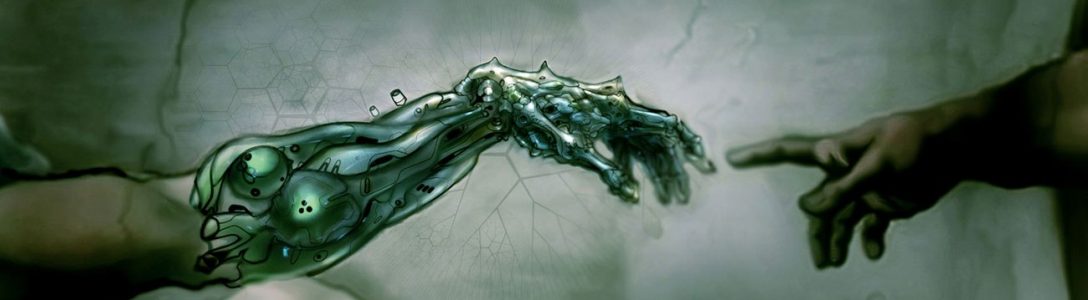
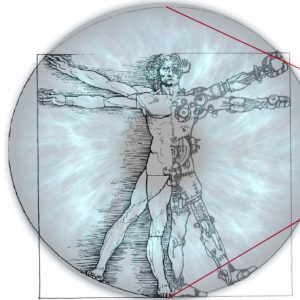
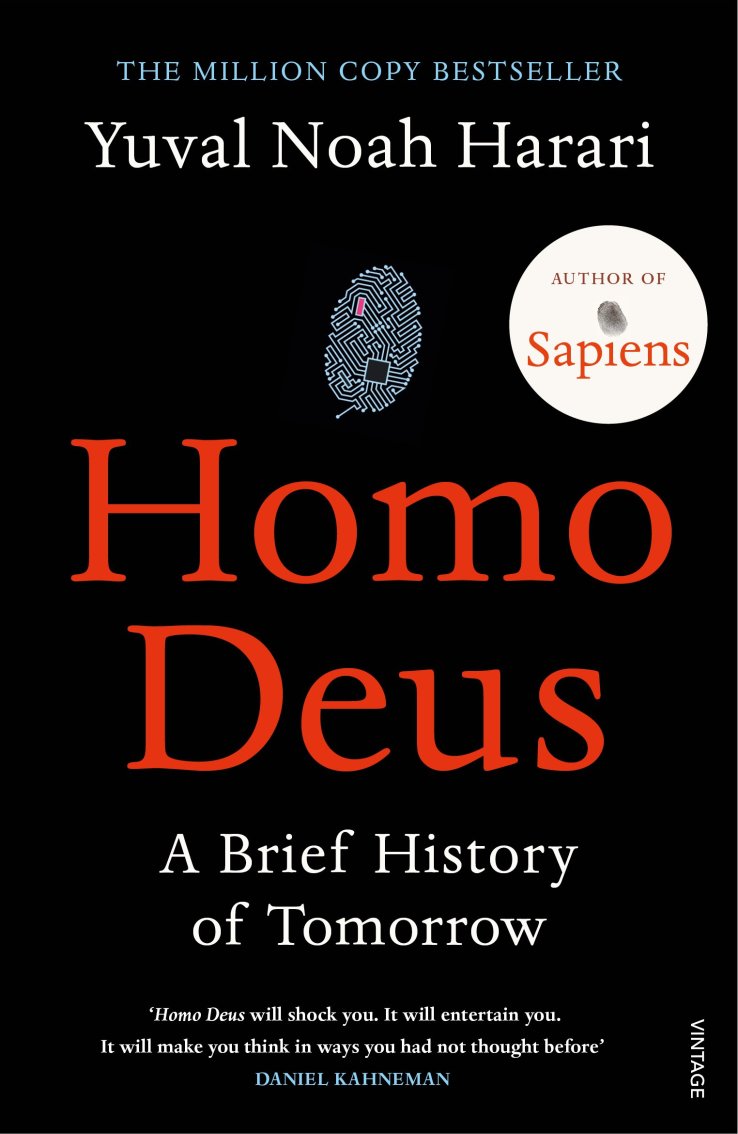
Though it does not seem to end up saying anything on a scale of grandeur to justify the title, rather appearing to peter out on the cusp of transitioning from a commentary about to humanity’s past to a substantial exploration of future possibilities, Yuval Noah Harari’s work of popular non-fiction about our possible trans- or posthuman future, Homo Deus: a Brief History of Tomorrow (2015) does cluster together a selection of interesting ideas in a manner worthy of some scrutiny.
“Humans conquered the world thanks to their unique ability to believe in collective myths about gods, money, equality and freedom – as described in Sapiens: A Brief History of Humankind. In Homo Deus, Prof. Harari looks to the future and explores how global power might shift, as the principal force of evolution – natural selection – is replaced by intelligent design.
What will happen to democracy when Google and Facebook come to know our likes and our political preferences better than we know them ourselves? What will happen to the welfare state when computers push humans out of the job market and create a massive new “useless class”? How might Islam handle genetic engineering? Will Silicon Valley end up producing new religions, rather than just novel gadgets?
As Homo sapiens becomes Homo deus, what new destinies will we set for ourselves? As the self-made gods of planet earth, which projects should we undertake, and how will we protect this fragile planet and humankind itself from our own destructive powers? The book Homo Deus gives us a glimpse of the dreams and nightmares that will shape the 21st century.”
The core idea of the text would have to be that “Science is converging on an all-encompassing dogma that organisms are algorithms and life is data processing.” While evolution has programmed such algorithms into the human species in the form of drives and constructs such as the narrated self, this poses the problem as to how these adaptations can continue to be valorised once algorithms of greater information-processing power are produced artificially, surpassing the accumulated wisdom of evolved drives in the efficiency with which they facilitate the propagation of an increasingly enhanced humanity or post-humanity… or just information flows in some form.
Early on in the text, Harari makes much of the idea that a good portion of human knowledge is intersubjective fiction, evolving as a means to promote human co-operation. For example, institutions such as money, nation-states and corporations feature in the modern-day versions of such fictions that allow for enhanced coordination of action towards life-sustaining goals. This is a familiar kind of social constructivism, of the flavour that makes a strong distinction between brute, physical, scientifically verifiable facts, and institutional facts, ala Searle’s The Construction of Social Reality, but with the variation of aligning this distinction with that between factual and fictional discourse (all of which I personally endorse).
Harari goes further, however, in consigning all religious and moral discourse to the intersubjective, socially constructed, fictional discourse category, and this is somewhat problematic. The well-known test for determining whether widely accepted facts are socially constructed is to pose the hypothetical of all humanity suddenly popping out of existence. According to the standards of the society that accepts the relevant facts, would the mere fact of their non-existence abrogate those facts? If so, apart from facts relating to humans and their physical bodies, this would indicate a dependence of those facts on the minds of those whose represent them, showing that they are merely intersubjective fictions. For example, money would be rendered as worthless pieces of paper or mere numbers on screens, losing its halo of intrinsic value. However, this is not what would happen with regard to beliefs held by people about gods and moral truths. A 21st-century atheist looking back on bronze-age societies might suppose that their moral and religious beliefs are primitive and clearly false, but this does not demonstrate that those beliefs were merely intersubjective fictions. They were harboured as beliefs about brute fact according to the best theories of the time about reality.
Why is this distinction significant? Firstly, if reduced to a pragmatic means of ensuring cooperation between human beings, fictional gods and morals are validly equated with other evolutionary adaptations generated to ensure the fitness of the species across a diverse range of environments and conditions. Secondly, as pragmatic constructs of evolution, they are linked to the algorithms already mentioned that will be surpassed by more efficient ones as technology continues to advance. This means that morality will change radically, and possibly becomes irrelevant, depending upon the capacity of interconnected networks of agents, with vast processing power, to adapt to changing conditions in a collaborative way without the need for such fictions. Yet, if morality and religion were never held to be intersubjective fictions, but facts with truth conditions anchored in reality, then they cannot be ruled out so quickly as a range of facts subordinate to the physical, naturalistic facts, with a looming expiry date.
Indeed, moral and other normative facts might persist as a domain of fact that such a reductive, scientifically-informed view of the world continues to leave out due to its inability to explain them. In this regard, it is interesting to note the tone with which Harari discusses the plight of animals due to intensive farming methods. His concern for their suffering is obvious, and yet there is nothing in the coming evolution of life and information flows that guarantees that the fiction of morality, if it persists at all, will take a form to preclude the suffering of “lower” forms of life. If anything, the opposite seems more likely, albeit for reasons that diverge from the enjoyment of deriving nourishment from the consumption of animal flesh.
If we are honest, we will admit that we still believe in moral facts as brute facts that would survive the end of the human race as we know it. Even if we claim otherwise, these beliefs still play the functional role of brute and absolute fact in the way that they motivate both action, and feelings such as anger and shame. If that is the case, then it does seem that Harari’s account of morality, and even religion, as intersubjective fiction is just an overly reductive view leaving something out that it cannot explain.
Of course, one of the claims of this blog has been that morality and normativity more generally are conceptually dependent upon inevitable consequences that can only be provided by an omnipotent person capable of suspending or varying the current natural laws. Thus, instead of seeking to become Homo Deus, an alternative might still be to reconsider the most plausible candidates for revelations of a truly cosmological Deus as the source of purpose and meaning that transcends mere fictions of social expediency.

 Theocentric Posthumanism
[…] my last post, here, I pointed out a way in which one futurist suppresses a tacit commitment to objective morality. […]
LikeLike