
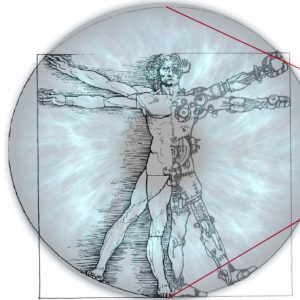
Humanistic presuppositions about individual and social development have provided the rationale for education since as early as Western culture’s Renaissance period. The belief that the individual could be reformed through education, to the end of bettering the condition of society as a whole, carried a practical kernel of humanism that sprouted into an explicitly anthropocentric philosophical revolution from the Enlightenment into the twentieth century. Philosophical humanism’s promotion of individual agency for universal betterment has been foundational to Western educational paradigms ever since, democratising the modern project of education.
The ascendancy of humanism endured into the twentieth century, until it was irretrievably shaken by a threefold crisis. Firstly, the popular experience of two world wars and the existential threat of the ensuing Nuclear Age undermined faith in humanity’s inevitable progress towards a utopian future guaranteed by benevolent technological advancement. Secondly, the success of scientific inquiry into the nature of the universe, initially bolstering confidence in humanity’s central place over all things, destabilised that picture as the inquiry turned back onto the inquirer, exposing an embodied subject whose capacities are distributed across localised and contingently realised forces continuous with those producing other living and physical systems. Thirdly, there was a growing suspicion that the demarcation between the human and the non-human coincided, not with a natural kind, but with the interests of dominant groupings in perpetuating power differentials across divides of race, class, gender and sexuality.
The resulting posthumanist age of the twenty-first century rejects the anthropocentric presuppositions foundational to Western mass education. In order to maintain its picture of humanity at the centre of all things, humanism had continued from medieval Christian cosmologies the assumption of a necessary harmony between a singular human nature and the fundamental principles of the universe, ensuring the epistemic and material progress of humanity when acting in accordance with our nature. Our posthumanist condition derives ultimately from the failure to discern any such resonances as our deepening understanding of the universe reveals it to be no respecter of persons. It increasingly seems that we must choose between feeble optimism about future forms of life, if not humanity’s future, offered by naturalistic posthumanists such as Haraway and Braidotti; and something like a theocentric posthumanism predicated upon a transcendent God who sustains the natural order so as to establish our otherwise contingent harmony with an indifferent universe.
Importantly, sustaining optimism via theocentric posthumanism, in this way, has distinctive consequences in an educational context hitherto governed by humanistic presuppositions, reconciling seemingly opposed paradigms in contemporary curriculum theory. The posthumanism of contemporary educational discourse is exemplified by the influence of Bourdieu’s sociological field theory in that it prioritises the production of the individual habitus by localised social and material forces, over any overriding coordination of dispositions by our shared humanity. Thus, the construction of knowledge is irreducibly perspectival, fundamentally structured by one’s positioning within class and cultural background. There is something unsettlingly paradoxical about such radical social constructivism, which is often not acknowledged. The underlying naturalism used to dismantle humanism’s essential personhood in a universe of impersonal forces is legitimised by scientific discipline knowledge that has been more successful in explaining and instrumentalising the phenomena of diverse experiential worlds than the pre-scientific folk theories native to those worlds.
This success of scientific discipline knowledge as a universal imposition on experiential knowledge motivates Bernstein’s contrasting code theory, which draws upon Durkheim’s distinction between sacred and profane discourses as a religious precursor to discipline knowledge. The distinction is used to explain how an independent discourse with internally consistent and experientially transcendent epistemic rules and practices can emerge from the broader lay discourse over which initiated experts acquire epistemic authority.
Young (2008, Bringing knowledge back in: From social constructivism to social realism in the sociology of education, Routledge) dubbed Bernstein’s defence of disciplinary knowledge ‘social realism’, setting it in opposition to the dominant paradigm of social constructivism, which is also epitomised by Bruner’s model of students constructing diverse experiential worlds. He argues that the latter unjustifiably reduces theoretical knowledge to an arbitrary elevation of the experience of the empowered and privileged over that of the disempowered. Such a conflation of experience and theory disregards the explanatory power and success in generalisation of discipline-based knowledge and the inability for everyday knowledge, tied to immediately practical concerns, to deliver the same. Furthermore, curriculum development then becomes an exercise in deciding whose experience should be promulgated as knowledge, and it deprioritises interventions to address the uneven distribution of experience relevant to the production of knowledge.
Even so, Young also rejects the dichotomy between such social constructivism and an educational traditionalism or neo-conservatism that regards the disciplines of the past as circumscribing fields of knowledge that stand outside of social and historical processes. In doing so, he notes that both sides of this debate hold to the assumption that knowledge can only be objective and universally relevant, transcending diverse experiential worlds, if it transcends historically and culturally local forces of socialisation. The contrary premise of social realism, offered as a middle way, is that, while the disciplines originate from and are conditioned by social and historical forces, these need not be of the same kind that explain the formation of non-cognitive social groupings and values. Thus, like Bernstein, Young highlights the Durkheimian view that cognitive interests developed within specialist fields of inquiry generate principles of autonomy that separate them from non-cognitive interests in a way that precludes the reduction of one to the other. In this way, the immanent, social character of theoretical knowledge ceases to count against its objectivity, instead becoming the grounds for codes, rules and practices directed towards truth and objectivity.
In addition to giving theoretical disciplines their due for producing objective and impartial knowledge, this middle way has implications for curriculum development. Young’s is a middle way between the insularity of conservative approaches, failing to adapt to innovations in contemporary delineations of knowledge fields in its reification of disciplinary boundaries, and the hybridity advanced by both postmodern and technical-vocationally orientated approaches seeking to reimagine and transcend disciplinary boundaries. Proponents of this hybridity fail to acknowledge the time and social infrastructure required to restructure and redevelop cognitive methods and communities of epistemic trust, and that such change must be generated from within existing disciplines for the new interests to be directed similarly towards objectivity.
The strength of social realism is in its top-down picture of the way disciplines afford undeniable benefits through their ordering of experiential worlds beyond the privileged discourse of expertise. However, the countervailing strength of social constructivism is that a candid examination of the bottom-up picture of the forces involved in the production of knowledge reveals insufficient resources to explain how certain regimented experiences come to possess a universal relevance and efficacy by abstracting away from localised experience. Though Durkheimian defenders of respect for disciplinary knowledge point to the explanatory and technical success of contemporary science, nothing in their account of disciplines as discourses with autonomous, cognitively interested epistemic rules and practices serves to explain how those discourses come to offer more powerful ways through which to engage with all experiential worlds.
After all, as Wittgenstein highlighted in his Philosophical Investigations, the question of whether or not one is correctly following abstract rules presents an ethereal complexity that can only be grounded holistically, in the resources of an entire form of life. So, rules followed by those initiated into a discipline, to insulate their discipline knowledge from their experiential knowledge, are highly likely to mean something different to peers approaching the discipline from diverse class or cultural backgrounds. Again, this is a consequence of no longer being able to assume an underlying core of human dispositions that grounds our common construction of knowledge. Thus, without some further explanation, the apparent agreement about epistemic rules and practices between initiates to a discipline is reduced to practical cooperability in academic discourse, which would preclude the universal relevance and efficacy of any one such set of rules and practices.
The tension between the top-down picture favouring social realism and the bottom-up picture favouring social constructivism cannot be resolved from within secular posthumanism. Enter theocentric posthumanism. It agrees that a lack of a common human nature, from a naturalistic point of view, validates the movement against humanism that has characterised contemporary humanities theory. However, it reinstates a derivative anthropocentrism proceeding from a divine privileging of a human species that is otherwise contingently realised in naturalistic history, to an extent that speaks of our utter dependence on the Deity for the reflected glory of human capacities. This view embraces the tension between social constructivism and realism, regarding it as irreconcilable by any naturalistic explanation. Instead, despite the lack of an intrinsic harmony between the universe and human embodiment, and between human embodiments, the creation of universal history by a singular mind underwrites the convergence of worlds realised through localised social and material forces, such naturalistically contingent convergence tending towards epistemic rules and practices that are universally powerful for understanding and shaping our physical and social worlds.
Realism is the winner at the level of the curriculum, and constructivism at the level of pedagogy. Young’s view of pedagogy is that it should be an induction into the rules and practices of a discipline. This does not duly acknowledge the gap between the schemata or worlds already constructed by the student in coping with their experiential world, through which they holistically interpret teacher instruction, and the schemata or worlds of those already inducted into the discipline. A set of bridging rules and practices might relate discipline knowledge to the diverse experiential knowledge of students. However, this would require student-specific rules and practices to emerge improbably from a shared form of life.
Consequently, the central role given to divine providence reconciles realist and constructivist intuitions about the process of learning reflected in contemporary education theory, justifying discipline knowledge as a social and epistemic achievement whilst also valuing students’ construction of knowledge from their diverse situatedness to forge idiosyncratic pathways to the same disciplinary objective. This is not an alternative to a more direct method of bridging experience and each discipline. Rather, every process of learning is equally contingent and unprincipled, notwithstanding the success of pedagogical heuristics.
Theocentric posthumanism reconciles the strongest intuitions of social constructivism and realism by allowing that processes producing and inculcating the epistemic rules and practices of disciplines need not be intrinsically or demonstrably reliable in order to yield discipline knowledge capable of powerfully reshaping experiential worlds by reorientating them towards greater objectivity. This concurrently facilitates both a commitment to the substantial objectivity of discipline knowledge and critical recognition of ways in which the production of knowledge can be biased towards reinforcing contingent ideological and material systems. The further suggestion, therefore, is educators should be open to professional learning exploring both objective discipline knowledge and critical perspectives concerning the social production of that discipline knowledge.

 Theocentric Posthumanism